This article is for general information only. It has been checked against the sources listed below but has not been reviewed by a medical professional.
Finding trustworthy child health information in Australia doesn’t have to be complicated. In today’s digital age, Australian parents and caregivers have access to a wide range of online resources. However, the reliability of this information can differ greatly. To determine its trustworthiness, consider factors such as authorship, evidence provided, timeliness, relevance to Australia, and any commercial motives. It’s crucial to remember that online information should complement, not replace, advice from a qualified health professional. Trusted child health information in Australia is essential for making informed decisions.
Trusted child health information in Australia: key takeaways
Verify the publisher and reviewers of health information.
Seek evidence-backed content with transparent sources.
Check the publication date and ensure content aligns with Australian guidelines.
Identify any commercial influences or exaggerated claims.
Always confirm health decisions with an appropriate health professional.
Vetting the source: who is behind the screen?
Finding reliable websites for child health in Australia starts with a practical question: who is responsible for the content? This can often be determined before reading a single word.
Domain extensions provide initial clues. Australian government sites use .gov.au, public universities use .edu.au, and recognised health networks operate under .org.au. While these domains suggest accountability, they don’t guarantee accuracy. Sites with generic commercial domains — .com or .com.au — require closer scrutiny, as anyone can register them.
Upon visiting a site, head to the “About Us” page. Healthdirect Australia highlights that reliable sites display the author’s name and professional credentials, such as Registered Nurse or General Practitioner. If the page describes a blogger, wellness brand, or supplements retailer, approach their health claims with caution.
Peak bodies and clinical networks differ from individual influencers. Organisations like the Royal Children’s Hospital Melbourne publish content reviewed by clinical staff, with reviewers identified by name and role. Social media accounts or personal blogs may mean well, but lack equivalent accountability. Transparency in authorship indicates a site takes its responsibility seriously.
Bold callout: If a site doesn’t disclose who authored its health content and their qualifications, that absence is telling.
Once you confirm the source, the next step is determining if their claims are evidence-based — which requires a different type of scrutiny.
Evidence versus anecdote
Understanding how to evaluate health information on the internet involves distinguishing between anecdotal and clinical evidence. Personal blogs and social media posts may offer reassurance but describe individual experiences that aren’t universally applicable. Clinical evidence, in contrast, aggregates data from many patients, controls for variables, and undergoes independent expert review before publication.
When reading a child health page, look for citations to peer-reviewed research or current clinical guidelines. The National Health and Medical Research Council develops and supports evidence-based health guidelines in Australia. A relevant, current NHMRC-issued or NHMRC-approved guideline, or a clear clinical review process, can signal quality — but check its scope, date, and applicability. Also, identify the author or publisher and how the content was verified. If a page makes strong health claims without supporting evidence or authoritative guidance, exercise caution.
Sources: Australian Commission on Safety and Quality in Health Care — Finding good health information online and NHMRC — Guidelines.
Look out for language indicating bias rather than balance. Claims of guaranteed, immediate, or complete results often suggest exaggerated certainty. Reliable sources acknowledge that medicine involves nuance — treatments vary across individuals, evidence can be mixed, and clinical consensus can change. A page presenting only one side, dismissing mainstream paediatric guidance, or framing scepticism as proof of a cover-up is worth questioning. Once assured a source handles evidence honestly, check if the information is current.
Currency and motive: is the information still safe?
For Australian parents seeking health information online, two questions help cut through the noise: when was this written, and who benefits if you believe it? Both are quick to ask and useful for filtering worthwhile content.
Currency is more important than most parents realise. Paediatric health guidance changes frequently. Check any page for a “Last reviewed” or “Last updated” date before proceeding. If there’s no date visible, treat the content with caution. If information is undated or appears outdated, check if a newer version or current Australian guidance is available.
Commercial motive is the second filter. A site selling a supplement, wellness programme, or proprietary test may present its product favourably. The Sydney Children’s Hospitals Network recommends checking if a site clearly discloses its funding sources and separates editorial content from advertising. If sponsored content blends into articles, or if disclosure statements are buried or absent, that’s a warning sign about the site’s reliability.
Bold warning: Broken or missing “about us” and “funding” links are red flags. A trustworthy site makes this information easy to find, not something you have to search for.
With these two filters applied — recency and motive — you’re better positioned to explore sites that consistently meet both criteria. Several Australian portals offer reliable starting points, as detailed in the next section.
Trusted Australian health information sources
When you need trusted sources for children’s health, starting with the right portals simplifies the process. Four Australian resources consistently meet the evidence, currency, and motive tests outlined earlier.
Raising Children Network offers up-to-date, evidence-based and scientifically validated parenting and child-health information. It does not allow advertising and is funded by the Australian Government Department of Social Services Families and Children Program.
Healthdirect is Australia’s national public health information service, funded by state, territory, and federal governments. It provides a symptom checker, a nurse-staffed telephone line, and written health guidance reviewed to consistent editorial standards. Operating outside the commercial model, its information isn’t influenced by product sales. The Royal Children’s Hospital Melbourne publishes clinical fact sheets written by specialist clinicians and reviewed regularly. Each sheet addresses a specific condition or procedure in plain language, making them useful for appointment preparation or understanding a diagnosis.
Sydney Children’s Hospitals Network provides paediatric safety and injury-prevention resources, including guidance on evaluating health information itself. Knowing how to assess a source is as valuable as the source.
These portals offer reliable starting points. Even with strong sources, a quick personal checklist helps apply consistent judgment — as provided in the next section.
Your reliability checklist
A quick, consistent checklist is the most practical tool to apply before trusting any child health information found online. Five questions cover the essentials.
- Check who published and reviewed the information.
- Check the evidence and direct sources.
- Check the publication or update date.
- Check its relevance to Australia.
- Check for commercial influence or exaggerated certainty.
Check the URL first. Domains ending in .gov.au or .edu.au indicate Australian government or university sources held to accountability standards. The Australian Commission on Safety and Quality in Health Care recommends starting here because these domains carry accountability that commercial sites don’t.
Verify who wrote it. Content written or reviewed by qualified medical professionals carries more weight than anonymous posts or general wellness blogs. The Royal Children’s Hospital Melbourne notes that a named author with stated qualifications is a clear marker of a trustworthy source.
Look for a recent review date. Paediatric guidance shifts as evidence evolves. Information updated recently is preferable — older content may reflect guidelines that have since changed. Better Health Channel points out that reputable sites will clearly display when content was last reviewed.
Assess the motive behind the page. Fear-based language, exaggerated claims, or heavy product promotion signal that commercial interest may be shaping the content. Balanced information acknowledges uncertainty; it doesn’t push you toward a purchase.
Always confirm with a professional. Online information should never replace professional medical advice. Use this checklist to vet what you read, then bring your questions to a GP, paediatrician, or child health nurse. In any emergency, call 000.
Once you’ve found information you trust, keeping a clear record of it — alongside your child’s appointments, documents, and health history — is the natural next step.
Organising your trusted health records
Finding reliable child health information is only half the task. Keeping a useful record of what you found and where you found it helps you return to authoritative sources when needed. Note the site name, the date you visited and the key guidance you took from it. This can also make it easier to share accurate background with a GP, paediatrician or child health nurse before an appointment.
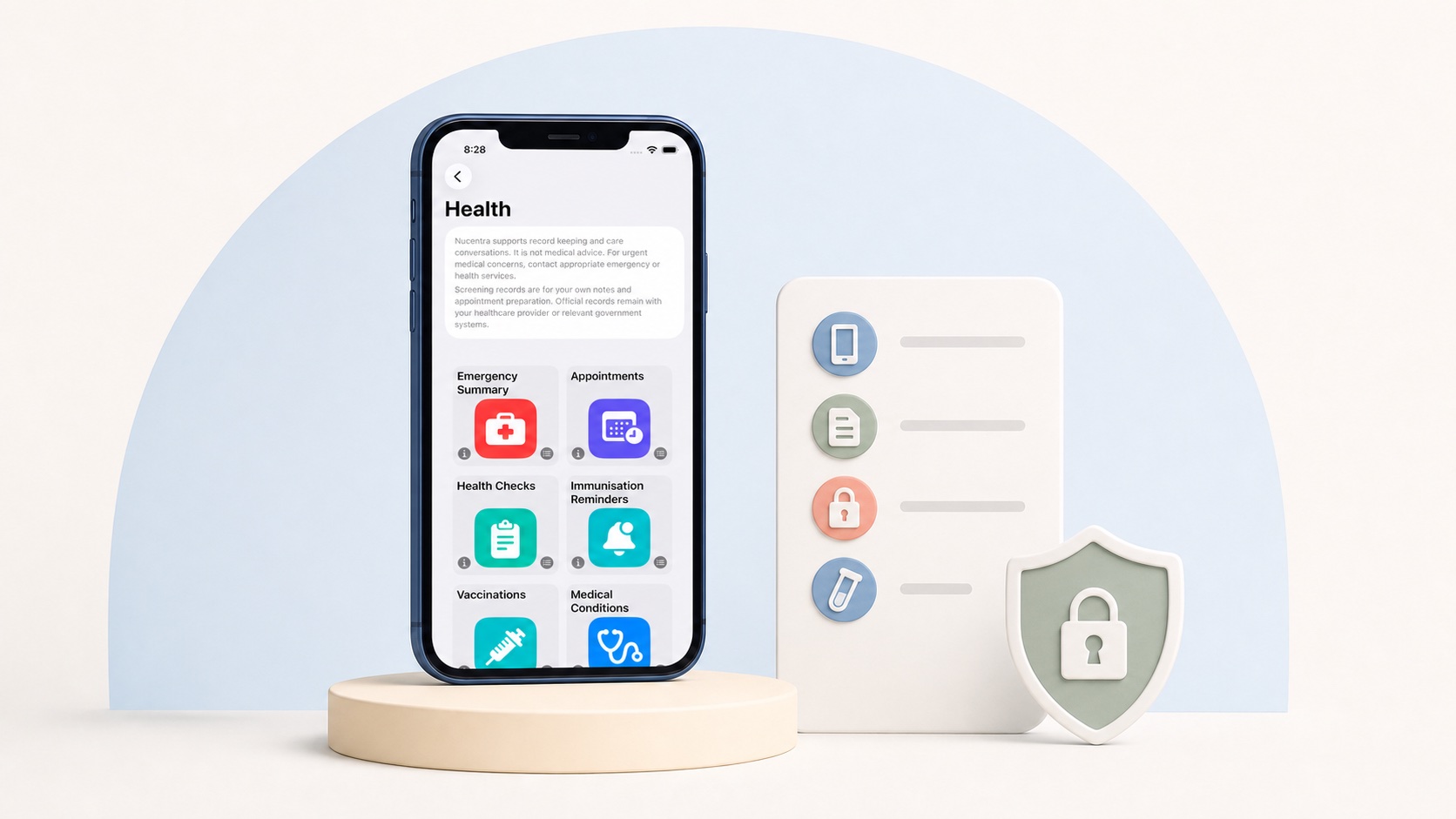
Privacy-conscious parents often prefer to keep that kind of family health data close rather than spreading it across multiple cloud-based services. A local-first approach — where information is stored on your own device rather than automatically uploaded to third-party servers — gives you more direct control over who can access it and when. That’s a practical consideration worth weighing, particularly when records include details about a child’s health history or care needs.
This article provides general educational guidance only. It does not replace advice from a qualified health professional. Organised records can support conversations with health professionals but do not replace professional advice. If you have concerns about your child’s health, the Better Health Channel and Healthdirect both provide clear direction on finding trustworthy sources and knowing when to seek care.
Sources
- Australian Commission on Safety and Quality in Health Care — Finding good health information online (last updated 29 April 2026; accessed 2 August 2026).
- National Health and Medical Research Council — Guidelines (date not stated; accessed 2 August 2026).
- Royal Children’s Hospital Melbourne — How to find health information you can trust (updated July 2025; accessed 2 August 2026).
- Healthdirect Australia — How we develop health content that is trustworthy and safe (last reviewed January 2020; accessed 2 August 2026).
- Sydney Children’s Hospitals Network — Evaluating health information online (last updated 11 May 2026; accessed 2 August 2026).
- Better Health Channel (date not stated; accessed 2 August 2026).
- Raising Children Network — Raising Children Network philosophy (date not stated; accessed 2 August 2026).
This article uses Australian health sources. If you live outside Australia, check advice from your local health authority or healthcare professional.