
This article is for general information only. It has been checked against the sources listed below but has not been reviewed by a medical professional.
A first visit with a child and family health nurse can arrive during an already busy stretch. A short list can make it easier to find the records, questions and observations you want to share without turning preparation into another large job.
This guide is about practical preparation only. It does not tell you when a visit should happen, what a nurse must assess, what any symptom or result means, or what care your baby needs. Follow the instructions from your own child health service, hospital, midwife, general practitioner (GP) or other health professional.
Start with the appointment message
Child health services are organised differently across Australia. Use the booking letter, text, email or phone instructions from your own service as the main checklist. Before the visit, you might confirm:
- where the visit will take place
- the date and time shown in the latest message
- whether the service has asked for any particular form, card or record
- how to contact the service if an instruction is unclear
- any access, interpreter or support-person arrangement you have already discussed with the service
If the service gives you a specific list, use that list rather than a general article. You do not need to assemble documents that were not requested or that you do not already have.
Bring the parent-held infant health record
In Australia, the parent-held infant or child health record has different names and colours depending on the state or territory. You may hear it called a Blue Book, Red Book, Purple Book or another local name.
Pregnancy, Birth and Baby advises bringing your child’s Infant Health Record to child health nurse appointments. The book is used by parents and health professionals to keep relevant health and development information together.
Check your own book for any pages your service has asked you to read or complete. For example, Children’s Health Queensland explains how parents can use the Red Book before a health check. Requirements and sections vary, so follow the wording in your own record and the instructions from your service.
Other existing records you may choose to take
You may find it useful to place a few already-existing items beside the infant health record. Take only what is relevant, available or specifically requested:
- the appointment letter, text or email
- a Medicare card or other administrative details if your service asks for them
- a referral, discharge summary, report or result that has already been given to you and relates to a question you want to discuss
- a current medication or supplement list if you already keep one or have been asked to bring it
- contact details for a GP or other health professional, if relevant
- your short question list and a blank page or note for information from the visit
Administrative requirements are not identical everywhere. As one local example, Western Sydney Local Health District asks families to bring the Blue Book and Medicare card. Treat that as an example of a service-specific instruction, not a universal rule.
Write questions in your own words
A short question list is enough. It does not need medical language, and you do not need to decide what an observation means before you mention it. Prompts you could complete include:
- What would I like explained in plain language?
- Is there a form, letter or result I want help understanding?
- Is there something I have noticed that I want to describe?
- Is there a day-to-day care topic I want to ask about?
- Which contact should I use for routine questions after the visit?
- Is there anything the service wants me to bring or complete next time?
Pregnancy, Birth and Baby suggests using the infant health record to write down questions or concerns for a health check. Your list can be much shorter than the examples above. Choose the points that matter to you.
Describe observations without interpreting them
If there is something you want to remember, write it as a plain observation rather than a diagnosis. You might note what you noticed, when you noticed it and the question you want to ask. If you already have a relevant record, message or photo, note where it is rather than creating a new tracking routine.
You do not need to collect every feeding, sleep or care detail for this checklist. Bring only the notes that help you explain your question. The nurse or another health professional can decide what information is relevant and explain what it means.
This article does not cover urgent care. If you need medical help, contact an appropriate health professional or emergency service rather than relying on an appointment-preparation checklist.
A one-page first-visit checklist
Confirm
- latest appointment date, time and location
- the service contact shown on the booking information
- any items or forms specifically requested by the service
Pack if relevant and available
- infant or child health record book
- appointment message or letter
- administrative card or details requested by the service
- relevant records already supplied to you
- current medication or supplement list if requested
- questions and observations you want to discuss
- something to take notes on
Leave space to write down
- plain-language explanations you want to remember
- documents or information the service gives you
- who to contact for routine follow-up questions
- any next steps the health professional explains
It is fine if several boxes do not apply. The purpose is to reduce last-minute searching, not to create a complete record before the visit.
Using Nucentra as an optional local companion
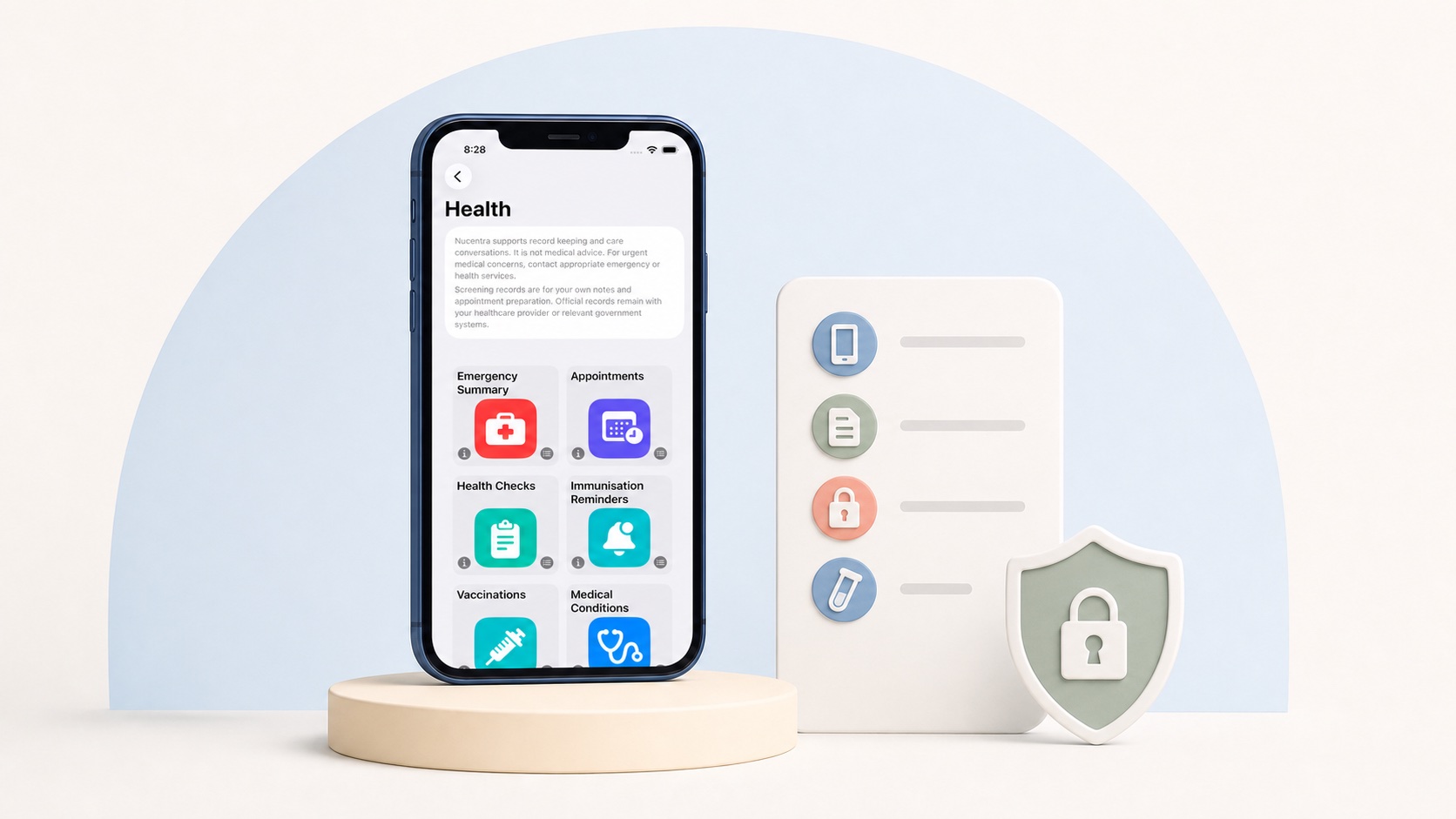
If you already use Nucentra, its current iPhone and iPad version can be used as an optional place for parent-entered appointment details, preparation notes and records where those features are available in your installed app version. Current app records are kept locally on the iPhone or iPad where Nucentra is used.
Nucentra does not currently provide active cloud record sync, family sharing, clinician access, artificial intelligence (AI) analysis or cross-platform access. It does not replace your child’s infant health record, a health service’s records or professional care.
Learn how Nucentra works today, read the current Nucentra Privacy Policy, or visit Nuco Tech Support for product help. For downloads, visit Nucentra on the App Store.
Sources
- Pregnancy, Birth and Baby — Child health nurses: what do they do? (last reviewed December 2024; accessed 2 August 2026).
- Pregnancy, Birth and Baby — Routine health checks for babies and children (last reviewed September 2023; accessed 2 August 2026).
- Children’s Health Queensland — Red book (personal health record) (last updated September 2023; accessed 2 August 2026).
- NSW Government, Western Sydney Local Health District — Newborn baby care in Western Sydney (date not stated; accessed 2 August 2026).
- Nuco Tech — Nucentra (date not stated; accessed 2 August 2026).
- Nuco Tech — Nucentra Privacy Policy (last updated 16 July 2026; accessed 2 August 2026).
This article uses Australian health sources. If you live outside Australia, check advice from your local health authority or healthcare professional.